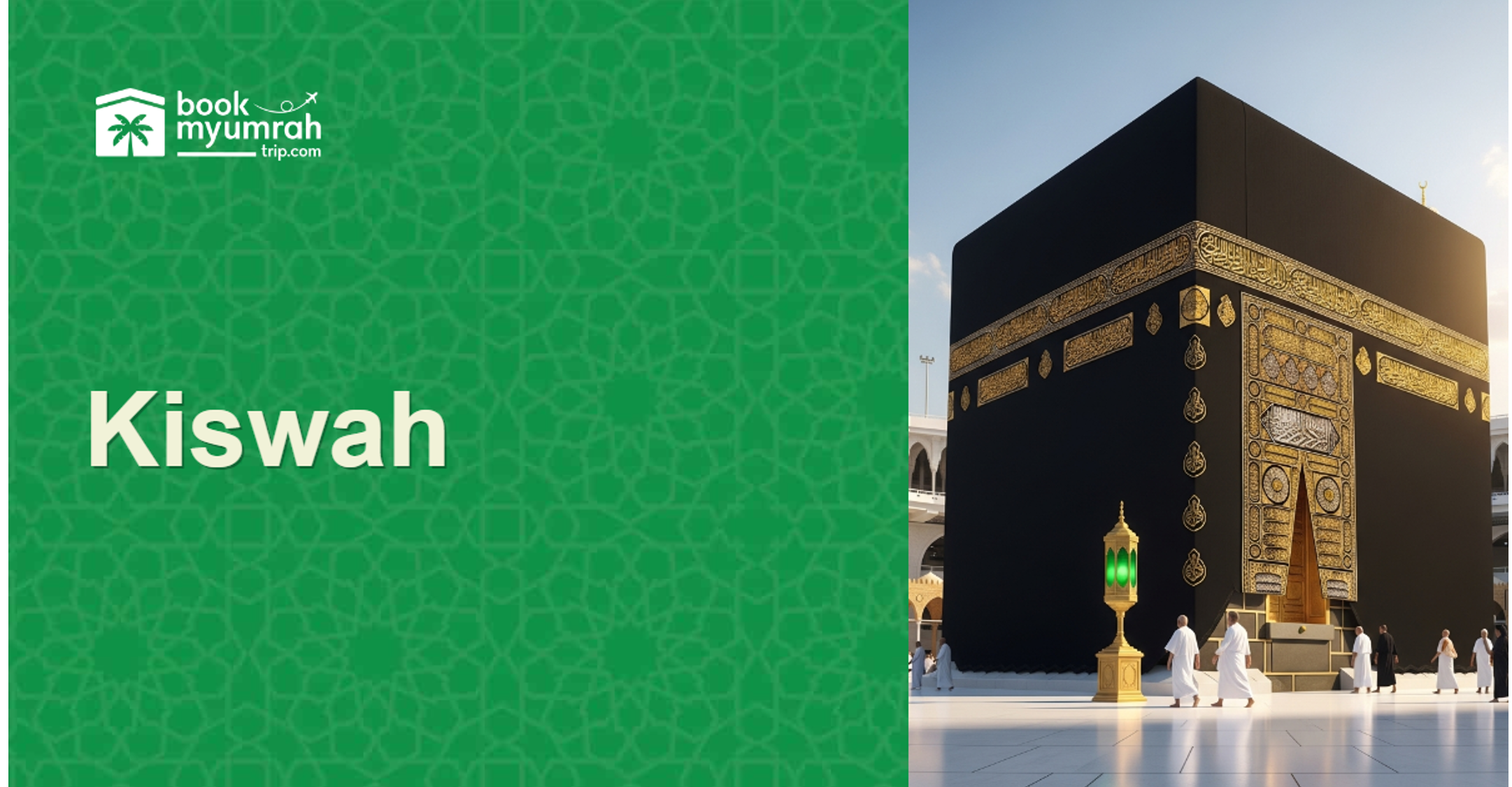
“Kiswah” The cloth draping the Kaaba

Draped over the cubic heart of Islam, the Kiswah is a sacred symbol seen by millions. And its profound story is known by fewer. Embroidered with verses, this black cloth is proof of centuries-old tradition, unmatched craftsmanship, and faith.
This black drape is more than just a cloth. It shows a deep expression of respect and dedication. This visual symbol of faith gets renewed every year in a ritual that shows the unity and continuity of the Muslim community.
Here in this blog, let's learn together about the cloth woven with piety and tradition and some more interesting facts and the availability of this beautiful covering, the Kiswah.
The Kiswah Cloth's History and Craftsmanship
It is a century-old tradition at the Kaaba. In the pre-Islamic era, Tabu Karab Aswad the king of Hummayur in Yemen was the first person to cover the holy shrine, Kaaba. After the conquest of Macca, our prophet (S.A.W.) kept the old one as it was. He didn’t replace it until a woman burnt the old one during scenting with an incense. It was then covered with a Yemeni cloth.
Color of Kiswah
The Kiswah was originally draped with the red and white colored strips of cloth.
The Seljuk Sultan covered it with yellow brocade.
The "Al-Nasir" caliph of the Abbasid empire (750 CE to 1258 CE) changed the color of the Kiswah to green.
Later on the color of the Kiswah changed to black brocade and has remained its color to the present day.
The modern Kiswah is made of high-quality black silk that has been embroidered with gold and silver threads and has lines from the Quran written in beautiful Thuluth calligraphy.
The King Abdulaziz Complex for Kiswah in Mecca is a special place where trained artists carefully hand-embroider this work. Each stitch is done with great care and respect.
How is the Kiswah made and used?
The Kiswah fabric is not a single piece of fabric. It is made up
Drapery (Kiswah): It is a black cloth. It is used to wrap the walls of the holy Kaaba.

Belt (Hijaz): This is a thick, embroidered band that circles the Kaaba. Some verses from the Qur’an are written on it.
Door Curtain (Burqu): This is a decorated curtain that hangs over the Kaaba’s door. It is also stitched with gold and intricate patterns.
Each part represents a distinct facet of devotion.
Nearly 200 technicians are involved in this process of making Kiswah. They use material over
670 kilograms of silk
150 kilograms of gold and
100 kilograms of silver
This level of detail shows how culturally and religiously important every fiber is, making the Kiswah a work of art in the Islamic style.
The Kiswah's yearly renewal and its importance
Every year on the 9th day of the month of Dhul al Hijjah. A new Kiswah is put in place of the old one.
This ceremony, which officials and pilgrims attend, is very important to the spirit. Taking off the old covering for a short time shows the Kaaba without the Kiswah, showing its stone structure. This is an uncommon sight that reminds people of the Kaaba's lasting nature beyond its decorations.
This change represents a fresh start and a cleansing, which fits with the Hajj ideals of oneness and repentance. People work together to lift and secure the new Kiswah around the Kaaba.
This process needs respect and coordination, and it sometimes makes people feel emotional. Then, the old Kiswah is carefully cut up, and the pieces are given as gifts or kept for historical record. This cycle of renewal strengthens the living tradition of Islam by linking the past and present via a physical act of prayer.
The Kiswah is now a living emblem that is always new but has its roots in old traditions.
How to Get Kiswah: Things to Think About and How to Get It
Getting a piece of the Kiswah is a dream come true because it connects to the sacred site. Getting real pieces is hard because they are sacred and difficult to find. As gifts of honor, Saudi officials give portions of the old Kiswah to mosques, Islamic organizations, and important people around the world.
And if you want to get kiswa, you should know that commercial sales are uncommon, and you should be careful with any online deals to avoid getting scammed.
Sometimes, licensed sellers or charity auctions will sell little pieces for a lot of money because of their spiritual and material importance.
Cost of Kiswah
As per the size, origin, and quality of its craftsmanship, the cost of Kiswah cloth ranges from hundreds to thousands of dollars. If you want to buy Kiswah cloth, get the credentials from reliable sources or Saudi religious groups.
Also, copies or inspired pieces of art are easier to get and can be used as religious objects without claiming to be from the real Kiswah.
To receive Kiswah, you need to be patient and respectful. This makes sure that getting it is in line with moral and spiritual values.
A Unique Look at the Kaaba Without Kiswah
Seeing the Kaaba without the Kiswah is a rare moment.
The uncovered Kaaba is a plain stone structure. It is possible to witness this moment during the changing ceremony of Kiswah. This view shows that the Kiswah is an honorable garment. It adds to the Kaaba's holiness but doesn't define it.
Seeing this can help us better understand the rites and symbols of Islam, which shows how tradition and transcendence work together.
Conclusion: The Kiswah's Lasting Legacy
In short, the Kiswah is a pretty cover. It tells us a story about faith, history, and community. Every part of it, from its complex craftsmanship to its renewal, shows a strong spiritual dedication.
As we think about the Kiswah, remember how it brought Muslims all around the world together.