My Father Did Tawaf in a Wheelchair. Here’s Everything We Wished We’d Known First.
Team BookMyUmrahTrip
My father had his knee replaced two years before we finally booked his Umrah. The surgery went well. Walking around the neighbourhood, climbing stairs all of that came back. But we kept putting off the trip because none of us were sure how it would actually work at the Haram. Would he be able to do Tawaf? What about Saʼi? We had questions and no reliable place to get answers.
I’m sharing this because I suspect a lot of families are in the same position. The information exists, but it’s scattered and often vague. What follows is the practical version the stuff we learned from doing it, and from the people we met along the way who had done it before us.
The short version: it is absolutely doable. With some planning, the experience can be remarkably smooth.
The Booking Stage Is Where Most Problems Start
We almost got this wrong. My father’s airline did not ask about mobility requirements when we booked online, and it didn’t occur to us to volunteer the information until a few days before departure. We called and they sorted it out, but it was avoidable stress.
Tell the airline at the time of booking. Not at check-in, not the day before at the time of booking. Most carriers will arrange wheelchair assistance from the kerb all the way to the seat. If your family member uses a powered chair, call the airline separately to go over battery rules. Lithium-ion restrictions are not consistent across airlines or routes, and you do not want this conversation happening at the departure gate.
On the hotel question: we stayed about 800 metres from the Haram and it was fine, but we would have chosen differently if we were doing it again. Under 500 metres makes a real difference when you’re visiting multiple times a day. Call the hotel before you book and ask specifically:
Lift internal dimensions some older hotels have lifts that look fine on paper but won’t fit a standard wheelchair
Bathroom setup grab bars, roll-in shower, or neither
The actual route from street level to the room, including any steps or narrow corridors
Whether any staff are available to assist if needed
The hotels closest to the Haram Ajyad, the towers around Abraj Al-Bait are expensive. But the tradeoff is fewer metres covered each day, which adds up to considerably less fatigue across a week.
Getting There: Jeddah Airport and the Drive In
King Abdulaziz Airport has wheelchair assistance but it gets stretched during peak seasons. My father waited nearly 45 minutes on the way back. Book the service before you travel through your airline, and build slack into your schedule.
Jeddah to Makkah is around an hour by road. Non-Muslims cannot enter Makkah, so if you’re arranging private transport make sure the driver is Muslim. If you’re using a tour operator or group package, specifically ask whether the vehicle has proper wheelchair access. This question gets nodded through a lot without anyone actually checking.
Inside the Haram: Better Than You’re Probably Imagining
My father had never been to the Haram before. I’d been once, years earlier, so I knew roughly what to expect in terms of the scale of the place. What neither of us expected was how well it actually handled a wheelchair.
Entry points: not every gate is equally accessible, but many have ramp access and lifts. The gates on the King Fahad and King Abdulaziz sides are the most reliably wheelchair-friendly. When in doubt, ask the security staff in our experience they were helpful and knew exactly where to direct us.
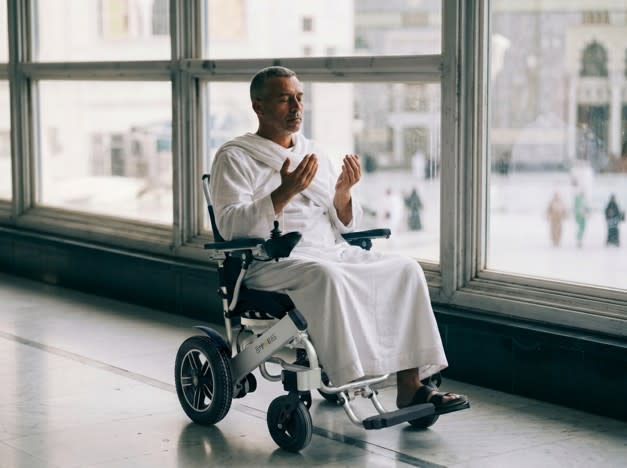
Tawaf: this was the part my father was most nervous about and it turned out to be the easiest. We did ours on the first floor, which has a designated wheelchair lane running parallel to the main Tawaf circuit. It was significantly less congested than the ground floor we moved at a steady pace the whole way around. The surface is smooth, the lifts work, and the lane is wide enough for larger electric chairs.
Saʼi is genuinely straightforward. The corridor between Safa and Marwa is flat, wide, fully enclosed and air-conditioned. Seven passages, around 3.6 kilometres in total. My father said it was the most physically comfortable part of the whole trip.
Zamzam stations are throughout the complex. A few of the older dispensers sit higher than is ideal, but we never had trouble getting water. People help.
On the Wheelchair Itself This Matters More Than People Realise
We rented a manual chair from inside the Haram for one visit early in the trip. It worked, but having a porter handle every movement including every stop my father wanted to make for dua, every moment he wanted to just sit and look at the Kaaba felt wrong. It wasn’t how he wanted to experience it.
We switched to an electric rental for the rest of the trip and it changed things immediately. My father could move when he wanted to move, stop when he wanted to stop. He spent nearly an hour in the wheelchair lane on the first floor one evening, just doing dhikr slowly, at his own pace. That wouldn’t have been possible with a porter.
We used Assist Haramain, which delivers the chair to your hotel in Makkah and Madinah. Having the same chair throughout the trip rather than figuring out a new arrangement each time was worth it. When you’re choosing a rental service, ask about battery range per charge and what happens if the chair needs attention while you’re using it. Also confirm Madinah coverage if you plan to visit Al-Nabawi.
Madinah
Masjid Al-Nabawi is well set up for wheelchair access wide corridors, ramp access at most gates, large open outer areas. The one thing worth knowing in advance: the Rawdah Al-Sharifah has scheduled visiting times for wheelchair users and those with disabilities. Check with the mosque accessibility office when you arrive, because the schedule changes based on how crowded the mosque is.
A Note on the Religious Rulings
My father asked his imam before we left, and we also looked into it ourselves. The short version, for anyone with the same concern:
Tawaf in a wheelchair is completely valid. What counts is the wheelchair moving around the Kaaba the pilgrim does not need to be walking.
Saʼi by wheelchair is permissible if the pilgrim cannot walk.
A mahram or carer accompanying a wheelchair user does not affect the validity of their own Umrah.
If a ritual genuinely cannot be completed due to incapacity, consult a scholar there are accommodations, and the religion accounts for real human limitation.
The Practical Checklist
Things to have sorted before departure:
Mobility assistance requested with the airline at booking, not at check-in
Hotel accessibility confirmed by a direct phone call, not just the website
Medications packed with documentation a translated physician’s letter helps at Saudi customs
Electric wheelchair rental confirmed with hotel delivery for both Makkah and Madinah
Saudi Red Crescent number and hotel emergency contacts saved before you land
Tour operator or travel group told about mobility needs in writing, not just verbally
My father cried during Tawaf. I don’t think I’ve ever seen him cry before, not like that. He’d waited years for that moment partly because of the knee, partly because we just didn’t know how to make it happen. Once we sat down and actually planned it, it wasn’t nearly as complicated as we’d built it up to be in our heads.
If someone in your family has been putting this off for the same reason, this is worth the planning. It really is.
This article was contributed on behalf of Assist Haramain, an electric wheelchair rental service for Hajj and Umrah pilgrims in Makkah and Madinah. Visit assist.haramain.com for more information.