7 Essential Rules for Praying While Traveling in Islam
Team BookMyUmrahTrip
•8 min read
Traveling can be adventurous, or sometimes it may become entertaining too. And in Islam, it may be a cultural dive for you. Being a Muslim, it also brings important spiritual considerations. During your journey, a question will stick in your mind: "How to pray while traveling in Islam?"
The wisdom of Islamic jurisprudence (fiqh) provides clear and compassionate concessions to make your worship consistent. No matter where you are. This guide will teach you how to pray while traveling in Islam, which simplifies the concepts of qasr and Jam prayer explained through a fiqh lens. So, when you're on a business trip or a family holiday, understand the fiqh of prayer that will help you to fulfill your duties with confidence.
What Is Considered Traveling in Islam?
Before applying any concessions, we must define the journey itself. Traditionally, classical scholars based "safar" (travel) on distance. The most common view, derived from the practices of the Prophet Muhammad (peace be upon him) and his companions, sets the threshold at approximately 48 miles or 80 kilometers (about a 2-day caravan journey in the past). Reference : https://sunnah.com/muslim:691.
This is the distance at which the concessions for salah while traveling Islamic guidelines begin. However, intention and duration matter. The purpose is typically a journey that takes you beyond your city's or town's boundaries.
A commute to work does not qualify, but a cross country trip does. Modern scholars also advise applying the local custom if people in your region consider a particular journey to be "travel," the concessions likely apply. This common sense approach is central to the fiqh of prayer while traveling.
Shortening Prayers While Traveling
The primary concession is Qasr shortening the four-rak'ah prayers. This is a fundamental answer to how to pray while traveling in Islam. For the four rak'ahs of Dhuhr, Asr, and Isha prayers, a traveler can do Qasr in their rak'ahs and pray only two rak'ahs. The three rak'ahs of Maghrib prayer and two rak'ahs of Fajr prayer will not change.
To perform Qasr, you simply form the intention (in your heart) to pray the shortened prayer as a traveler. The prayer itself is performed in the usual manner, just with fewer rak'ahs for the applicable prayers. This is a cornerstone of traveling prayer rules in Islam.
Combining Prayers During Travel
Another traveling prayer rule in Islam is Jam' combining two prayers in one timeframe. This is often paired with shortening and is especially useful during long transit days. There are two types:
Jam' al Taqdim: It is a combination of prayer in advance. e.g., praying Dhuhr and Asr together during Dhuhr time
Jam' al Ta'khir: It is delaying prayer into the later time. e.g., praying Dhuhr and Asr together during Asr time.
This is perfectly permissible for travelers facing difficulty in praying each prayer separately on time. You still pray each prayer in its proper sequence to make a separate intention for each, but you do so consecutively within one combined time period.
When we discuss qasr and jam prayer, it’s important to note that combining the prayers is a strong concession from the Prophet’s Sunnah. Some scholars view it as suitable for times of great difficulty, like continuous travel, rather than automatic use.
Which Prayers Can Be Shortened or Combined While Traveling?
As per the Sunnah and the Quran:
1. The Prayers That Are Shortened
Only the obligatory prayers that are 4 rak’ah (units) are shortened to 2 rak’ah. This applies to:
Zuhr Prayer: You can offer the 4 rak’ah of zuhr prayer shortened to 2 rak’ah.
Asr Prayer: In Asr, you have to offer the 4 rak’ah of Asr prayer to 2 rak’ah of Qasr.
Isha Prayer: And 4 rak’ah of Isha are shortened to be offered as 2 rak’ah of Qasr.
2. The Prayers That Are NOT Shortened
Maghrib Prayer: The 3 rak’ah of Maghrib will not be shortened and remains 3 rak’ah during travel.
Fajr Prayer: This Fajr prayer also does not change. 2 rak’ah of farz salah and remain the same as 2 rak’ah during travel.
Jam (Combine): As per the fiqh of prayer, while travelling, you can combine two of the prayers at one time.
It is combining two prayers and offering salah at one time.
In your journey, if Qasr is applicable, then you can shorten your prayer and combine them.
During Qasr:
Prayers that can be combined but not shortened: The 3 rak'ahs of Maghrib's prayer and 2 rak'ahs of Fajr's prayer cannot be shortened even if Qasr is applicable in your journey. And Fajr is never combined with any other prayer.
How Long Can You Pray as a Traveler?
"Once I reach my destination, for how long do I continue shortening my prayers?" This is the question of many Muslim travelers. And the scholarly opinions vary for this, but a widely followed view is that you pray as a traveler (Qasr) for up to fourteen full days and nights in one location.
If you intend to stay in a place for less than this period, you continue shortening. If you intend to stay for fifteen days or more from the outset, you are considered a resident and should pray the full prayers immediately. If your stay becomes unexpectedly prolonged, you resume full prayers after the fourteenth day.
This rule helps maintain the spirit of the concession it’s for the traveler, not the temporary resident. These traveling prayer rules in Islam are designed for your ease.
Praying While Traveling by Plane, Car, or Train
Modern transport has posed many challenges. The core principle is to pray on time if possible. How to pray while traveling in Islam in these scenarios? This is where you have to follow the method of performing the salah while traveling Islamic guidelines.
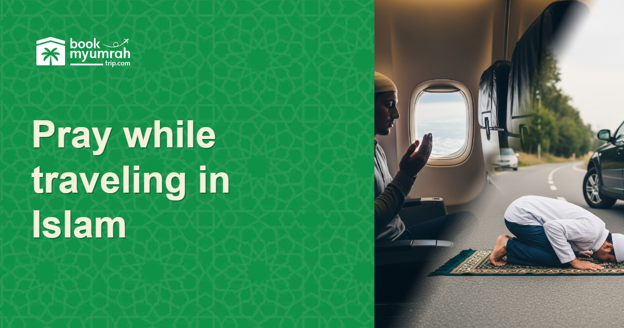
On a Plane: Pray sitting in your seat if you cannot stand or face the Qiblah precisely. Make the motions of ruku' and sujud lower than usual. Use the seat-back table as a prostration surface if needed. You can pray in this manner rather than miss the prayer. Calculate prayer times based on your departure point, destination, or according to the time zone you are flying over. Scholars differ, so choose a consistent method. Combining prayers is highly recommended here.
In a Car/Train: If you are a passenger and the vehicle can stop, then you can stop and pray as usual. If it is not possible, you may pray in a similar way to the method of an airplane, and combine prayers as the fiqh of prayer while traveling is needed.
Common Mistakes Muslims Make When Praying While Traveling
Not Shortening Prayers Out of Ignorance: Some think it’s optional or less virtuous. It is a confirmed Sunnah and a mercy you should embrace.
Overcomplicating Qiblah Direction: Facing the Kaaba is obligatory for offering salah, but when you are in a moving vehicle and cannot determine it. You can pray in the direction of travel or with your estimation.
Delaying Prayer Unnecessarily: Concessions are not an excuse for laziness. Always try to pray within the combined or prescribed times.
Inconsistent Application of the 14 Day Rule: Be clear about your intention for staying. And apply the rules to avoid confusion.
These will ensure that your connection to Salah will remain constant and accessible, which will transform your prayer from a burden into a source of strength and tranquility throughout your travels. So, learn and apply these rules to navigate your journey with confidence.
FAQs:
How do Muslims pray while traveling according to Islamic fiqh?
According to Islamic fiqh, Muslims follow two concessions to offer prayer during travel: one is shortening of four rak'ah prayers to two rak'ahs, i.e., Qasr, and the other is combining two prayers, i.e., Jam (Dhuhr with Asr, Maghrib with Isha), within one time period to reduce hardship. Combining two prayers is optional, but Qasr is obligatory.
What distance qualifies as travel for shortening prayers in Islam?
A distance of 80 kilometers, or 48 miles, from one's city boundaries is considered to shorten prayers. It is matched with the traditional Islamic definition of a journey (safar). Local custom is also considered.
Can you combine and shorten prayers while traveling?
Yes, as per the Islamic fiqh rules, while traveling, you can combine and shorten prayers. For example, a traveler can combine Dhuhr and Asr during Dhuhr time.
How long can a traveler continue praying Qasr in Islam?
If a traveler intends to stay in a location for less than 14-15 days, they continue shortening prayers. Upon intending a stay of 15 days or more, they should pray the complete prayers.
How do you pray on a plane or in a car when traveling in Islam?
Standing and facing the Qiblah is not possible for you. So, you can pray while sitting. Make gentle motions for bowing and prostration. It is recommended to combine prayers in such scenarios. The key is to perform the prayer to the best of your ability within its time.
Tawaf al Wada: The Complete Guide to the Farewell Tawaf for Umrah and Hajj
Learn about Tawaf al-Wada, the Farewell Tawaf for Umrah and Hajj rules, and a step-by-step guide. How to plan your departure around it with BookMyUmrahTrip.
Umme Ayesha
Read
7 Essential Rules for Praying While Traveling in Islam | BookMyUmrahTrip