Hero background

Blog.

The Quran and Emotional Intelligence: How Islam Teaches You to Master Your Emotions
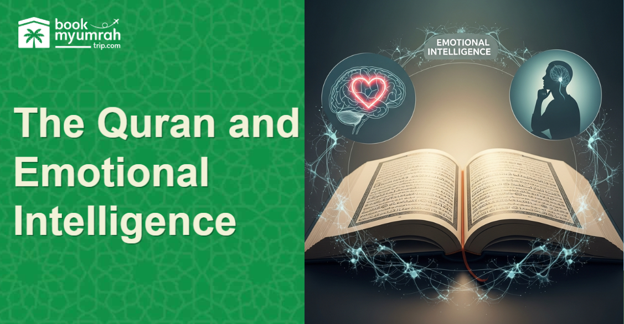
Cover Image for The Quran and Emotional Intelligence: How Islam Teaches You to Master Your Emotions

Can you imagine the key to gaining the right balance of our emotions was given to humans centuries before present-day psychology called it “emotional intelligence”? Emotional intelligence (EQ) has emerged as a highly trending and indivisible aspect in recent years, mainly in success, leadership, and interpersonal relations. Now, how does Islam relate to it? The Quran and Islamic teachings had already provided the entire blueprint for understanding and controlling man’s emotions long before psychologists could give any definition.

The Islamic viewpoint sees emotions not as something that makes us weak, but, on the contrary, as the very core of humans. When guided towards faith, they result in spiritually mature and harmonious individuals. The religious book encourages the believing people to use their hearts and minds in sync to find a balance between their inner and outer worlds.

What is Emotional Intelligence According to Faith?

Emotional Intelligence is a broad aspect. It is a set of skills that lets you understand personal feelings, how to handle these feelings wisely, and connect with people in a kind and fair manner. The five factors that the current models emphasize are self-awareness, self-regulation, motivation, empathy, and social skills, which are the basic areas of emotional intelligence.

These elements have been the significant sources of Islamic morality and spirituality for a long time. The Quran has forever taught the believers to introspect; think about their inner world and will, asking Muslims to be conscious and responsible.

This verse is quite consistent with the essence of Emotional Intelligence: change begins within. 

Indeed, Allah does not change the situation of a people, until they change what is in themselves.” ~(Quran 13:11)

A person who observes and takes action over his/her emotions will not just be capable of carrying the characteristic of the positive change to his/her personality, but to the people who will surround him/her in society.

The Quranic Foundation of Emotional Mastery

a. Self-Awareness: Awareness of Inner States

The Quran is the one that challenges the believers to think over what they are doing and the reasons to do so. The initial task in becoming aware of him or herself is learning what will make one feel the way he or she feels and how this can influence decision-making.

“And do not be among those who have forgotten Allah, so He made them forget themselves.” ~(Quran 59:19)

Here, forgetting oneself means losing the sense of one’s moral and emotional condition. The real consciousness is a result of spiritual consciousness, of consciousness of the position of the heart in the presence of Allah.

b. Self-Regulation: Learning Restraint and Patience

One of the central teachings of Islam is to learn to manage emotional responses. Do you feel anger, pride, and envy more often? They are the actual challenges to your spiritual growth. Allah loves individuals who control anger and forgive others.

This is what Emotional Intelligence is dictate your emotions instead of letting them dictate you.

Muhammad ﷺ: The Living Model of Emotional Balance

Prophet Muhammad ﷺ is one of those examples who demonstrated an outstanding skill of managing emotions and demonstrating empathy in every field of his life. He was calm, just, and compassionate, even when facing hostile people.

When slandered, he was patient. When wronged, he forgave. When people looked up to him, he listened to them. These are some of the examples from the Hadith that demonstrate; dominance is not power, but the balance of feelings is.

His leadership included emotional balance, and his humility, compassion, and patience became the basis of the interaction and decisions.

Daily Learning: How to Practice Emotional Intelligence in Everyday Life

Muslims are advised to develop emotional cognizance and control by daily learning, through the Quran and the Hadith.

  • Anger Management: Islam provides feasible ways of managing anger - rearranging the physical position, turning to Allah as a place of refuge, or performing ablution. Such measures are spiritual and psychological relaxation methods.

  • Dealing with Envy and Resentment: Envy has the power to eat the heart; disrupt your peace and shukr. Islam recommends that the faithful concentrate on appreciating and being happy because everything that reaches a person is a blessing from the wisdom of Allah.

  • Active Listening and Empathic Communication: There is worship in being respectful in dialogue and being an attentive listener. A wiser reaction instead of a reactive one will result in better social and emotional relationships.

Islamic History Teachings

Power in Islamic history has depicted emotional wisdom in action. Umar ibn al-Khattab (RA) was a powerful individual, yet he cried in his prayers in humility. He had a humble heart, full of reason and compassion.

Ali ibn Abi Talib (RA) did not even attack an opponent who spat on him in the battle, saying that his response would be based on personal anger and not justice. This scene of restraint shows how beautifully emotional intelligence is fed by faith.

The history of Islam has proven that not only was emotional control a personal virtue, but also a social duty for scholars, rulers, and simple believers.

Emotional Intelligence and the Strength of Muslim Faith

Emotions guide all the areas of the Muslim faith in terms of prayer, forgiveness, charity, and life in the community. Learning about your emotions would allow you to be sincere and persistent in your actions.

A heart that’s directed by Sunnah, the teachings of the Quran, is not affected by challenges, humble when it achieves something, and merciful towards other brothers. That means emotional intelligence solidifies faith as it guides our emotional reactions based on spiritual values. It makes worship a conscious and heartfelt process and relations opportunities for mercy and development.

Conclusion

The Quran and Hadith provided a deep structure of insights to master our emotions, way before modern psychology came to label ‘emotional intelligence’. Through Islam, emotions are not to be repressed and allowed to run blindly, but they are managed in terms of awareness, reflection, and by faith.

Under the influence of Islamic teachings, emotional intelligence becomes more than a skill; it becomes a worship, a self-purification. It challenges the believers to act prudently, treat others with generosity, and think earnestly.

When a human being learns to master their emotions via faith, harmony is achieved between heart and mind and eventually, between the person and their Creator.


The Quran and Emotional Intelligence: How Islam Teaches You to Master Your Emotions | BookMyUmrahTrip