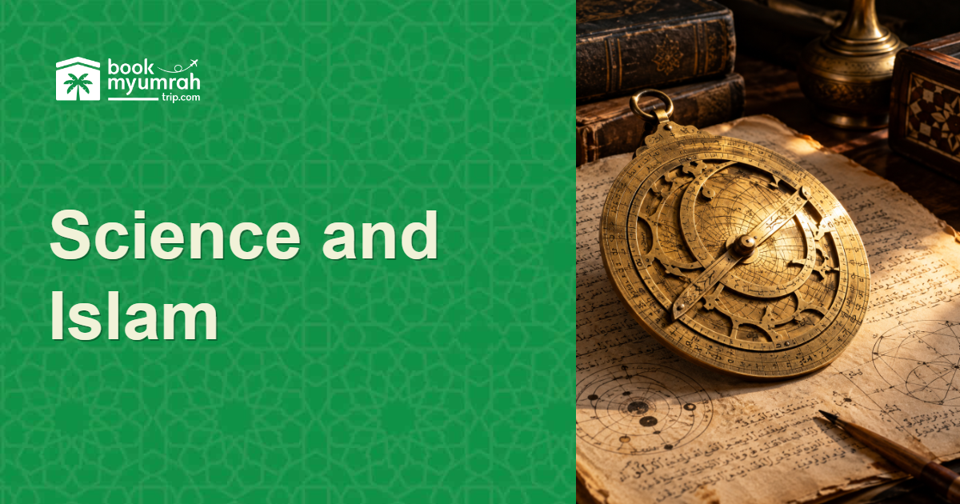
Science and Islam: A Journey Through Faith, Knowledge, and Discovery with BookMyUmrahTrip
Umme Ayesha
•13 min read
Science and religion are usually treated as rivals. One deals in proof, the other in belief. They supposedly can't share the same room.
History disagrees. The same civilization that produced the Quran also produced the first hospitals, the roots of algebra, and the earliest work on optics. Science and Islam grew from the same soil.
How a modern Muslim can hold both faith and inquiry without tension
Islam's View of Knowledge
The first word revealed in the Quran was "Iqra" read. Not pray. Not fast. Read.
Before any instruction about worship came down, the command was to seek knowledge. The Quran has more than 700 verses that ask people “to observe and reflect” on the world around them.
"Will you not then see?"
"Do they not reflect?"
"Will you not use your intellect?"
Observation isn't a threat to faith. It's built into it. The Prophet (PBUH) said seeking knowledge is an obligation on every Muslim. Not just religious knowledge. Knowledge of the body, the stars, the seas, the world.
That's where any real conversation about science and Islam starts.
Knowledge also comes with responsibility.
A person may have advanced scientific knowledge, but how that knowledge is used is an ethical question.
Medicine can save lives.
Technology can connect people
Engineering can improve living conditions.
At the same time, knowledge can be misused.
Islamic teachings about responsibility and justice, and to avoid harm can therefore become part of a wider discussion about how knowledge should be used.
Is Science Compatible with Islam?
There is no simple reason why scientific study and Islamic faith must be opposites. They often deal with different kinds of questions.
Science generally investigates:
How natural processes work
What can be observed and measured
How physical systems behave
What evidence supports a particular explanation
Religion can address questions such as:
Why human beings exist
Questions of morality
Spiritual responsibility
Worship and belief
The purpose and meaning of life
For example, astronomy can explain the movement of planets. It cannot, by scientific measurement alone, settle every question about the purpose of human existence.
That difference is important when discussing Science and Islam.
It also prevents a common mistake where people turn religion into a science textbook and look to science for answers to every deep question about life and God.
Scientific Phenomena in Quranic Revelation
The Quran is not a science textbook. And it never claims to be. But its descriptions of natural phenomena have drawn attention from scientists for centuries.
The developing human embryo - Surah Al-Mu'minun uses "alaqah," a clinging substance. Modern embryology describes early implantation in similar terms
The expansion of the universe - Surah Adh-Dhariyat has been compared to the 20th-century discovery of cosmic expansion
Deep sea darkness and internal waves - Surah An-Nur describes conditions oceanographers later documented
The water cycle - Surah Az-Zumar matches what modern hydrology confirms.
None of these verses were written as scientific claims. They were written as signs pointing to a Creator. The point isn't that the Quran "predicted" modern science. The point is that its descriptions of nature have held up as human understanding has grown.
The Rise of the Islamic Golden Age
During the medieval period, Islamic civilization built the world's top universities long before Oxford and Cambridge.
Baghdad was one of them. It became a major centre of scholarship.
Other cities played important roles too. These included Damascus, Cairo, and Córdoba. Several Persian and Central Asian centres were also part of this network.
Muslim scholars accessed global knowledge from Greek to Sanskrit but instead of blindly copying, they critically analyzed and advanced it.
They:
Translated older works
Compared different ideas
Corrected earlier calculations
Added their own observations
Developed new methods
Wrote new books and reference works
This is one reason The Rise of the Islamic Golden Age remains important in the history of global knowledge.
There was no single moment or same story everywhere. Each region developed on its own timeline, with scholars working in different worlds of politics and society.
Muslim Contributions to Science
Every major field has a Muslim scholar somewhere in its early history:
Medicine
Al Razi - medical encyclopedia
Al-Zahrawi - surgical instruments
Ibn Sina - Canon of Medicine (European textbook for over 600 years)
Chemistry
Jabir ibn Hayyan - He introduced the techniques of distillation and crystallization.
The word "alcohol - Comes from the Arabic word "al kuhl"
Astronomy
Al Battani - Calculated the length of the year.
Al Biruni - measured the Earth's radius.
Observatories in Maragha and Samarkand produced star charts used for centuries
Geography
Al Idrisi He drew a world map in the 12th century. It was used in Europe for over 300 years.
Philosophy and logic
Scholars such as Al-Farabi and Al-Ghazali influenced how Islam viewed logic and ethical values. Each came from a culture that encouraged curiosity.
This spirit continued across generations. It was not the work of a few isolated geniuses. This is why many readers remain interested in "Quran and scientific facts" as a reflection of that ongoing curiosity.
Together, these examples show that "Muslim contributions to science" spanned multiple disciplines. And it shaped knowledge for centuries.
Mathematics: The Language of the Universe
Mathematics was one of the strongest areas for Muslim scholars a key example of “Islam and science facts” working together is:
Muslims needed geographical calculations to determine the direction of the Kaaba.
Calendars required astronomical observation and calculation.
Al Khwarizmi's work on algebra is particularly well known.
Other scholars also made progress in:
Geometry
Trigonometry
Arithmetic
Astronomy
Mathematical calculation
Mathematics had everyday uses.
For example:
Merchants needed calculations for business.
Surveyors needed accurate measurements.
Astronomers needed mathematical tables.
Scholars used mathematics to calculate inheritance.
This practical side of mathematics is easy to overlook.
For many scholars, numbers were not simply symbols written on a page. They were tools that helped solve real problems.
That is one of the quieter connections between islam and science facts.
How Islamic Worship Advanced Applied Science
Daily worship created practical problems. Solving them pushed science forward.
Prayer times - required accurate timekeeping and solar observation
Qibla direction - required spherical geometry and geographical coordinates
Zakat - required arithmetic and bookkeeping systems
Hajj travel - required navigation across land and sea
None of these were framed as science projects. They were acts of worship. But each one demanded measurement, calculation, and recording. The daily rhythm of Islamic life turned every mosque and madrasa into a working lab.
Physics and the Birth of Experimental Science
Ibn al Haytham is often called the father of optics. His bigger contribution was method.
He insisted theories be tested by experiment, not argued from authority
His Book of Optics showed light travels in straight lines
He demonstrated that vision happens in the brain, not the eye
He documented how to run controlled experiments and record results
That approach observation, hypothesis, experiment, conclusion later shaped what Europe called the scientific method. It came through centuries of Muslim scholarship, not from nowhere.
Science and the Quran: A Careful Conversation
We need to be most careful here. When we try to match every modern discovery with a Quranic verse, we risk reading more into the text than it contains.
The discussion around the Quran and scientific facts becomes stronger when it avoids exaggerated claims.
The Quran can encourage Muslims to observe nature and think about creation.
Science can then investigate the natural world through:
Observation
Testing
Measurement
Evidence
Repeated investigation
Some discussions of the Quran and scientific facts focus on human development, mountains, water, the heavens, and other natural subjects.
Muslims may see these references as signs of “Science in the Quran” that encourage reflection.
At the same time, a scientific theory should not be treated as a Quranic fact simply because someone finds a possible similarity between the two.
This is particularly important because scientific explanations can develop when new evidence appears.
For a Modern Muslim, the Quran can inspire curiosity without putting a limit on scientific investigation.
Instead of saying, “The answer is already here,” a better attitude can sometimes be, “This verse makes me want to learn more about islam and science facts.
The Legacy Continues: Modern Muslim Scientists
Scientific work continues across the Muslim world and among Muslim researchers living in different countries.
A Modern Muslim may work in:
Medicine
Engineering
Computer science
Astronomy
Environmental science
Artificial intelligence
Biotechnology
Physics
Chemistry
Being a scientist does not mean that you have to give up religious belief. And having religious faith does not stop you from examining evidence and doing scientific research.
For a modern Muslim, science may be a career and a way of understanding the physical world, while faith provides personal beliefs and ethical values.
This is also how many approach Science in the Quran not as a replacement for research, but as an encouragement to pursue it.
Researchers today work internationally. Progress comes from different fields and joint projects that bring together people from many cultures.
How Parents Can Teach Children About Science and Islam
Parents do not need complicated lessons to introduce children to this subject.
Start with things children can see.
Look at the sky.
Watch the moon change shape.
Identify a few stars.
Talk about day and night.
Explain the basics of the solar system.
Read Quranic passages that encourage reflection on creation.
Ibn al Haytham
Al-Khwarizmi
Ibn Sina
Al-Tell stories about Muslim scholars.
Children often remember stories better than lists of dates.
Parents can introduce them to:
Biruni
Al-Jazari
Explain what each person studied and why their work mattered.
Connect everyday worship with learning.
Parents can explain:
Why prayer times involve the position of the sun
Why the Islamic calendar follows the moon
Why determining the Qibla requires geography
Why mathematics is useful for inheritance
Let children ask questions.
A child should not feel that asking “why?” is disrespectful.
Encourage them to:
Check information.
Read books.
Visit museums.
Conduct simple experiments
Speak with teachers.
Compare different sources.
This makes scientific knowledge in the Quran a starting point for curiosity rather than a subject that ends with memorizing a few claims.
Common Myths About Science and Islam
A few myths keep floating around. Worth clearing up.
Myth: Islam and science are opposites The opposite is closer to the truth. The Quran asks people to study the natural world, and Muslim scholars built entire fields on that foundation
Myth: The Golden Age was just translation Translation was the beginning, not the achievement. Muslim scholars corrected errors in Greek texts and produced original work in medicine, optics, and astronomy
Myth: Science and the Quran only align when you squint Some popular claims do require squinting. The broader relationship is straightforward. The Quran describes nature as a sign, and science studies nature
Myth: A modern Muslim can't be a serious scientist The list of Muslim Nobel laureates, researchers, and professors says otherwise
Myth: Science has replaced religion Science describes how the universe works. It doesn't answer why anything exists at all.
The point of discussing science in the Quran is not to find every modern theory in a verse, but to remember that the Quran invites us to study nature and science is one way we answer that invitation.
BookMyUmrahTrip and a Learning-Centred Pilgrimage
Most pilgrims travel to Makkah and Madinah with worship in mind. That's the core. Nothing replaces it. But a pilgrimage can also be a learning experience.
The Islamic sites in Saudi Arabia hold centuries of history. The cities that produced the Golden Age are woven into the landscape.
BookMyUmrahTrip helps pilgrims plan journeys that make room for both:
Guided Ziyarah to historical Islamic sites in Makkah and Madinah
Itineraries covering the major Islamic pilgrimage sites without rushing the rituals
Safe transport in AC vehicles, suitable for families and women
Flexible packages for travelers who want time at the Haram and time to explore
With BookMyUmrahTrip, your journey goes beyond rituals it becomes a chance to reflect on Muslim Contributions to Science and see how science and Islam have long inspired each other along the path of faith.
FAQs
Does Islam encourage the pursuit of science?
Yes, absolutely. Islam puts a lot of value on knowledge. The Quran constantly asks us to observe, think, and reflect - and seeking knowledge has always been seen as an act of worship.
What was the Islamic Golden Age?
The Islamic Golden Age was a time of great learning. Knowledge grew in many parts of the Muslim world. Baghdad became a major centre of study. Cairo and Cordoba also became known for their scholars. During this period, Muslim scholars worked in all fields.
Are science and Islam opposites?
No, Islam and science have never been opposites in Islam, worship and curiosity go hand in hand.
What contributions did Muslim scholars make to medicine?
From encyclopedias and surgical instruments to the Canon of Medicine, Muslim Contributions to Science continue to illuminate the enduring connection between science and Islam.
Who is known as the father of optics?
Ibn al Haytham. His Book of Optics worked out how vision actually functions and laid down the experimental method that Europe later adopted.
Did Muslim scientists contribute to early physics concepts?
Yes. Apart from optics, they worked on ideas about motion, mechanics, and astronomy. A few are commonly cited the description of the developing embryo, the expansion of the universe, the darkness of deep seas, the water cycle.
None of these verses were written as scientific claims. They were written as signs. The fact that they've held up as knowledge has grown is worth noting, but the Quran was never trying to be a science textbook. Much of their work became the groundwork for later physics.
Are there Quran verses believed to align with modern scientific discoveries?
A few are commonly cited the description of the developing embryo, the expansion of the universe, the darkness of deep seas, the water cycle. None of these verses were written as scientific claims. They were written as signs.
The fact that they've held up as knowledge has grown is worth noting, but the Quran was never trying to be a science textbook.
What does Islam teach about the environment?
That the natural world is a trust, not a possession. Humans are caretakers. Waste and cruelty to animals are discouraged. So is causing damage to land and water.
What is the main lesson from science and Islam?
That knowledge and faith aren't in conflict. The Quran treats nature as a sign. And studying nature is one way to engage with that sign.
How can BookMyUmrahTrip support a learning centred pilgrimage?
By planning Ziyarah to historical sites, arranging safe transport, and building itineraries that leave room for both worship and learning.
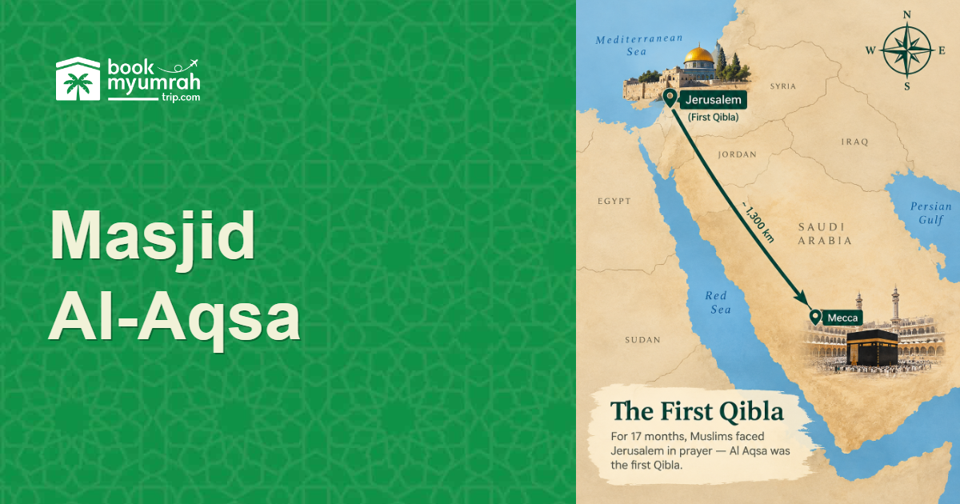
Al Aqsa Mosque: History, Importance, and Complete Guide to Islam’s Third Holiest Site
Al Aqsa Mosque—Islam’s third holiest site: the complete history, Islamic importance, and spiritual significance. Learn and plan your Umrah journey with BookMyUmrahTrip.
Umme Ayesha
Read
Science and Islam: A Journey Through Faith, Knowledge, and Discovery with BookMyUmrahTrip | BookMyUmrahTrip