Hero background

Blog.

What AI and Technology Mean for Muslims: Guidance from an Islamic Lens
Cover Image for What AI and Technology Mean for Muslims: Guidance from an Islamic Lens

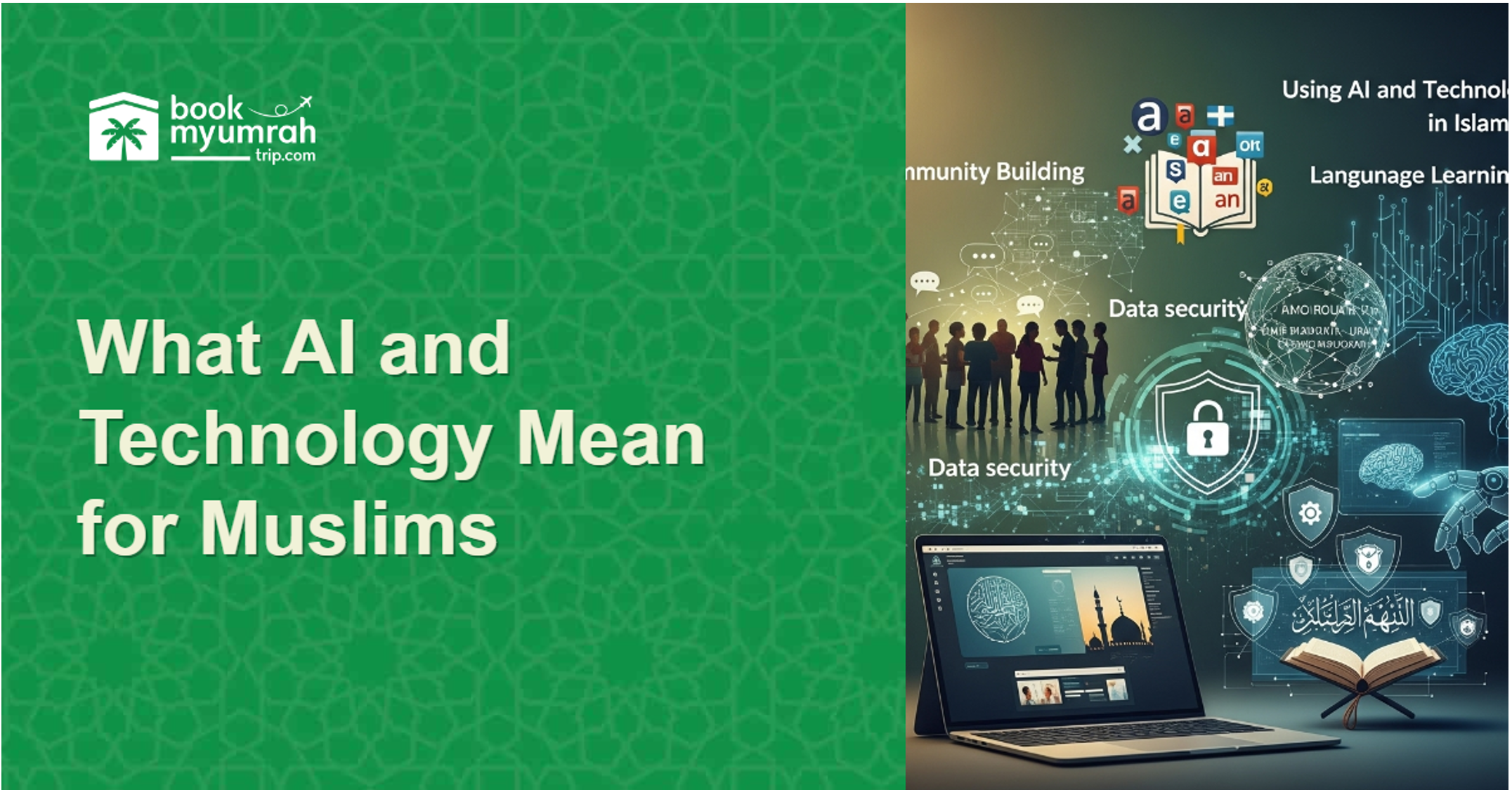
This is the era of Artificial Intelligence (AI), machine learning, and new technologies that are interfering in almost all spheres of life, including work, education, professional relations, and even spiritual practice. Being Muslims and a part of this Duniya, we cannot turn a blind eye to technology, and we cannot go with its use blindly. This is new ground that we must follow with the help of an Islamic prism, based on the Quran and Sunnah ethics and wisdom.

In one of the recent studies on the field of Islamic education, 77.7% of students supported the idea that AI tools enhanced comprehension. This demonstrates how willing young people are to apply AI even in the context of religious learning. But opportunity brings risk along.

Let’s understand what AI and technology can mean for Muslims what strenths it offers, what danger it presents, and how we can use it in a sacred, wise, and neutral way.

Does Islam Have Historical and Intellectual Foundations for Technology?

Islam had never discouraged knowledge, innovativeness, and exploration of the world. Influential contributions were made by Muslim scholars:

  • Al-Khwarizmi (9th century) introduced algebra and equations, after whose name the word ‘algorithm’ was derived.

  • The Banu Musa brothers, Al-Jazari, and others introduced early machines and automata, on which modern robotics works. 

  • Other philosophers, such as Al-Farabi, Ibn Sina, and Al-Ghazali, created logical, philosophical, and epistemological (knowing knowledge) concepts that lead reasoning, ethics, and decision-making processes today 

This legacy means that Muslims are not foreigners in the age of technology we possess a history of innovation. The present-day concept of Islamization of Knowledge is that modern subjects and fields like technology must become subjects of an Islamic worldview (i.e., knowledge is not value-free but must be subject to ethical and spiritual foundations). 
Opportunities: Areas Where AI/Tech Can Assist Muslims

1. In Islamic education and scholarship

  • AI systems personalize learning (adjust the pace, repeat the weak points), particularly in Quranic and religious education. 

  • Hadith, Tafsir, and classical Islamic texts can be cross-referenced via large language models and search tools to find information.

  • Artificial Intelligence can be used in the studies of hadiths to identify the chain of narration, authenticity flags, or textual variations.

2. In community services and everyday life

  • The assistance of AI can be used in health diagnostics, social welfare allocation, agriculture, and intelligent infrastructure.

  • In an actual case study, scientists applied deep learning to recognize proper Salat (prayer) positions with approximately 85% accuracy in categorizing the core positions.

  • Another example is where an AI plus fuzzy logic model is a prototype of a “smart mosque dome” that opens or closes based on weather or crowd density to increase airflow and comfort.

Such instances mark how AI can be used to elevate religious practice, monuments and infrastructure, and overall quality of life–-but only if we choose to stay guided by ethical values.

Risks, Ethical Challenges & Islamic Concerns

  • False information, delusion, hallucinations

AI (precisely generative AI) could create fake quotes, so-called hallucinated sources, and even flawed information. These falsities are specially more harmful in the religious sphere. How? That’s because fake hadiths, false fatwas, or misleading info might not guide by damage muslims.

  • Privacy, Data Security, Bias

AI is reliant on huge data. In case any personal, religious, sensitive, health, or social information is revealed and abused, then that is a breach of privacy and trust (amanah). Discriminatory training information may result in unjust treatment.

Islamic Principles and Directives of Using AI/Tech

To be safe, the following are some of the guiding Islamic principles:

  1. Intention (niyyah) and targeting benefit (maslahah)

In Islam, all actions are evaluated based on the ‘intention.’ When we want to use AI not to harm humanity but to make worship a little more convenient and promote justice, then it is acceptable and even encouraged.

  1. Avoiding harm (Sadd al-dhara'i')

The idea of blocking the means (sadd al-dhara'i), i.e., even legitimate tools should not be used to achieve destructive purposes, is often applied in Islamic legal theory. When it is likely that an AI tool will cause deception, addiction, or sinful use, then Muslims must not or should control it.

  1. Maintaining integrity, not deceiving.

False attribution, lying, and misrepresentation are big sins. It is forbidden to present the work of AI-generated content as the work of a scholar or to fake hadith.

  1. Maintaining dignity, fairness, and justice.

Algorithms should not be discriminatory or prejudiced. The Quran principle that talks about Allah commands us to do justice and benevolence is never more valid.

  1. Islamic jurisprudence of ijtihad, consultation, and oversight.

Muslim scholars, technologists, and ethicists have to practice ijtihad (new reasoning) to consider new use cases and provide directions or boundaries. In Muslim nations, the development of AI can be regulated through digital ethics bodies or councils.

Practical Advice for Muslims in the Modern World

  • Read and Gain Knowledge determine how AI functions and learn its capabilities. Digital literacy is a kind of worship because it is done to protect against being deceived.

  • Apply AI as a servant, not a master Never just blindly trust what you get, not even religious advice.

  • Fund ethical/Muslim-oriented AI projects Stimulate the creation of systems that inject Islamic values (e.g., content filters, fact checking, moral guardrails).

  • Community collaboration Academics and practitioners ought to develop policies, audit models, and sensitize.

  • Accountability and Transparency It is desirable to know the way the decisions are made in the AI systems so that human override is possible.

An indicator that the community is already taking part: the UAE Council of Fatwa has announced its intention to apply AI to assist in the issuance of fatwas without sacrificing Islamic guidance and values.

Take Away 

AI and technology are neither good nor evil; they are tools that mirror our intentions. Being directed by Islamic guidance and ethics, it is the responsibility of Muslims to use them wisely in order to promote justice and the good of humankind. 

May Allah (s.w.t.) bless us with wisdom to use technology for good and shield us against misuse, and may our innovations always follow His guidance. Amin!


What AI and Technology Mean for Muslims: Guidance from an Islamic Lens | BookMyUmrahTrip